
D1 Receptor Inverted-U Dynamics: Optimizing Prefrontal Efficacy
1. The Mechanism
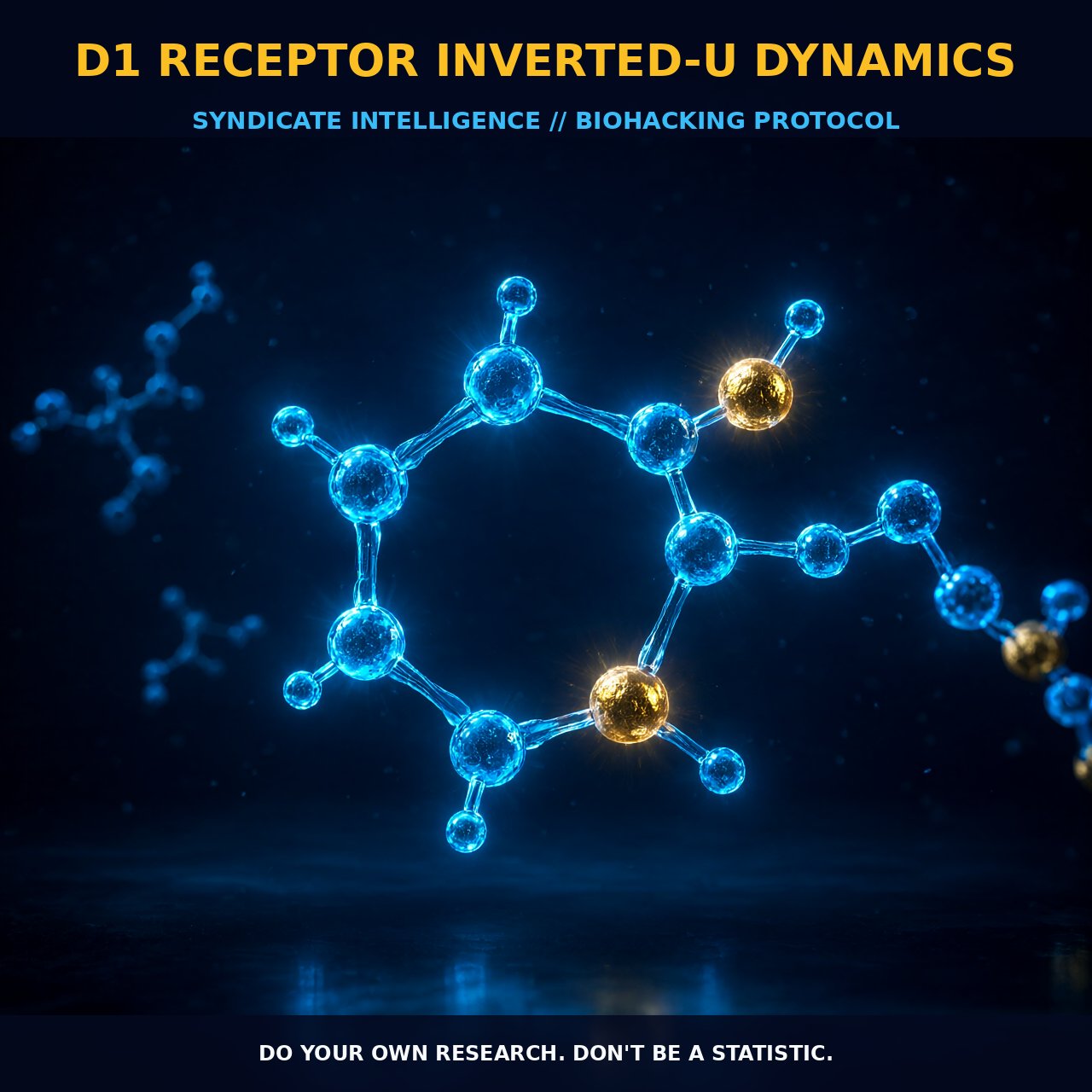
The prefrontal cortex orchestrates working memory through a precise dose-response relationship governed by dopamine signaling via D1-type receptors. This dynamic is visualized as an Inverted-U curve, where cognitive performance peaks within a specific efficacy zone. Performance degrades at both extremes: insufficient transmission impairs function, while excessive transmission causes overload, illustrating that the optimal state is not maximal firing rate but a balanced engagement.
This regulatory mechanism operates similarly to a hormonal negative feedback loop. The brain actively modulates synaptic strength to prevent signal saturation by adjusting the number of NMDA receptors through long-term potentiation (LTP) and long-term depression (LTD). This stabilization against signal noise ensures that prefrontal circuits remain clear and operationally intact, defining the ceiling of cognitive performance.
2. Biological Leverage
Targeting D1 receptors offers direct leverage over prefrontal cortical circuits, the critical hubs for higher-order thinking and executive function. Dopamine acts as a fine-tuner, optimizing synaptic efficacy and plasticity to support memory retention and attention. When the Inverted-U curve is optimized, the brain achieves a unique state: stability amid adaptability.
This balance lowers the synaptic noise floor, maximizing working memory capacity. Furthermore, D1 engagement supports long-term recuperative processes. The system utilizes LTD to erase old engrams, clearing irrelevant data without compromising existing knowledge structures. This dual action—stabilizing current signals while pruning historical noise—provides a robust framework for sustained cognitive clarity and functional resilience.
3. Tactical Implementation
Practical application requires maintaining dopamine levels within the therapeutic window that optimizes D1 receptor activity. Biohackers must monitor for signs of both under-stimulation (often seen in aging) and over-stimulation (common during acute stress), as both states shift the system away from its peak.
Strategies should prioritize gradual modulation over aggressive spikes. By supporting healthy dopaminergic tone and allowing LTP/LTD mechanisms to function synergistically, individuals can enhance working memory without triggering dampening effects. The goal is sustainable, biologically aligned enhancement that preserves the delicate equilibrium of prefrontal circuits.
Prostar Life Hack
Avoid dopamine saturation during high-stress periods by combining low-dose tyrosine supplementation with mindfulness breaks. This prevents the 'excess' side of the Inverted-U curve, keeping NMDA receptor regulation active and preventing signal noise from degrading working memory.
Prostar Life Hack
Avoid dopamine saturation during high-stress periods by combining low-dose tyrosine supplementation with mindfulness breaks. This prevents the 'excess' side of the Inverted-U curve, keeping NMDA receptor regulation active and preventing signal noise from degrading working memory.
[ AUTHOR: LEAD TECHNICAL RESEARCHER ]